
I can’t believe I did that.
The silent words echoed in my thoughts, searching all the corners in my brain for a reasonable answer. The feeling of dread, like the belated effects of a stimulant, coursed through my veins as I stood motionless under the showerhead the water sloughing off dust and grime from my skin. The certain risk to life and limb that I willingly accepted to get what I wanted – or what I thought I wanted – finally hit me in its totality, collected in the pit of my stomach and gathered enough mass to make my knees buckle.
More silent words, only this time, a question: Are you fucking crazy?
Yes: this just may be the first time I felt scared after what I’d done.
The party line I inherited from my Baby Boomer parents, “work hard and you will succeed” outlined a nebulous pathway to an unlimited field of possibilities. While it’s a Reasonable statement and, of course fundamentally accurate, It’s only when you reach a certain place in your life when it dawns on you. This aphorism is a selective half-truth, a paltry, still-unripe fruit discovered only after you peel away the many nuances and circumstances which mitigate or abet it. Some you’re able to control; others do their best to control you. Over time, I learned an alternative, more empowering interpretation: “don’t give up”. If nothing else, Tenacity is a kind of success.
After the typical period of indecisiveness many young people trip over, partially as a consequence of being paraded through the gauntlet of society’s preferences for what they should be, I decided that I wanted to be…something. Writing was, retrospectively, an inescapable directive; Mom, haunted by the specter of a deferred education, was deathly serious about literacy. Dad was a voracious reader. The attaché to words, as it happens, are letters. Because of reading I knew that I had to write because it gave me the kind of freedom I lacked off the page. Creating worlds during this age of inquiry was a terrific panacea for the limited range of motion bound by the rules in my home. But my ideas could never really be contained the same way. As a child, my choices echoed in my bones, in my mind, before I fully committed to any task. All the tools at my disposal, at that moment, then conspired to make the desire real.
In this case, I – the forty year-old child – had made up my mind to sneak into the Red Hook Grain Terminal and take pictures, and every fiber of my being was prepared to make that happen.
April, 2021
It had been five months since my migration to Brooklyn and my creative process was solidifying. Nearing the final stages of integrating photography with my writing, Brooklyn’s geography, an ongoing study, was the intuitive choice for practice/portfolio building. I was living across the street from Prospect Park and had voraciously consumed its contemplative, explorative and photogenic potential (in sleet, rain, snow, or sun). Within that span of time, I had been to/seen nearly every part of it, with or without a camera. Google Maps, that impartial travel guide, helped me choose Red Hook Park as my next green space. With my iPhone 11Pro in hand, I set out.
The walk from Park Slope to Red Hook felt like a cinematic experience curated by a director with only one technique under his belt: jump cuts. the way upper middle class/rich communities and enclaves broke away to low-res, industrial grit as I traveled west on 9th Street, then Third Avenue and then over the Gowanus Canal via the 9th Street Bridge was abrupt and without foreshadowing. There seemed no context to justify the abrupt shifts. When I reached the intersection of Lorraine and Hamilton Avenue, a huge shadow blocked out the morning sun above: the Gowanus Expressway. Like the snaking arm of a giant, it sheared through three neighborhoods at once, each with their distinctive feels, ethnic demographics and other barriers. It brought to mind a similar, albeit low-stooping behemoth: the lumbering exhaust shrouded road of the Bruckner Expressway, another of Robert Moses’ gifts to the city that kept on giving. Crossing into Red Hook proper, down Clinton Street I passed the Red Hook Recreation Center. Not a person in sight, but a casual panoramic glance told me everything I needed to know. It was a neighborhood painted in the broad strokes of what I experienced in my home borough.
Bronxites and Brooklynites have been trading stigmas across the divide of their apathetic, stuck-up neighbor (Manhattan) for generations. Most of those borough-centric opinions are inflated generalizations. As someone of both worlds by way of the southwest Bronx, my lived experience concludes that BK and the BX have a lot in common. What shocked me, though, was in this huge borough were enclaves disproportionately neglected as in my home borough. While the Bronx has advanced in some ways, the scars from the earnestly developed reputation of poverty remain vivid despite the land repurposing. Yankee Stadium is an easy out that comes to most peoples’ minds, followed by obtuse head-scratching for want of other places to name. For Brooklyn, marquee examples line up at the door: Spike Lee, Barclay’s, Bed Stuy (and the dim vestiges of Blackness on which this strength of cultural character was built, with the realities of poverty – an inescapable function of all high income economies – implicitly redacted). I recused myself of the burden to spin creative euphemisms likening a predominantly Black/brown neighborhood to something that it wasn’t, but the full impact of what I took in lay dormant, like the onset of a memory partially uncovered just before retreating into darkness again. After all, I wasn’t there for social commentary, but when you’re an Other, by fact of existence you ARE social commentary.
I entered the park at Bay Street and sat on the rickety bleachers to get my bearings. That morning, a few early runners paced themselves on the race track. From that vantage point, I saw more park to the south end. Relieved, I walked down Columbia Street. This portion, fenced off and thick with overgrowth had a “we’ll get to it later” written all over it. I was very familiar with places, people and situations like that. Later often meant, “no time soon”.
Fuck that. I decided on the spot that I didn’t walk two miles to look at a handball court, sorry-looking bleachers and an Amazon Fresh warehouse.
With Ikea(!) at my back, I squeezed under/between the loosely chained gate and into the forest of overgrown weeds. The surreal feeling of being in a forbidden place wore off within a few heartbeats; the nostalgic, in-desperate-need-of-renovations charm that permeated the conditions of my early upbringing/environment were definitely here.

Ironically, I felt more at home in these ruins than in my neighborhood of tight-lipped faces eyeing me with passive-aggressive suspicion, or doing their best to pretend they were not battling cognitive dissonance at what they were seeing; NOT a Caribbean woman pushing a stroller with a white child in it, and NOT a delivery uniform. The disorienting effects of class – by far the most rational of the four social constructs (race, gender, religion) which define, direct and inform our “modern” society and human experience – produces comfort and discomfort in uneven measures. Alone in this quiet and away from those pressures, I took a deep breath and smiled. Relaxation and peace wrapped around me in that isolation as the morning sun climbed higher.

“Isolation” didn’t quite fit, because others definitely had been here before me. I put my camera phone to work, capturing self-portrait and landscape shots of the graffiti-covered walls and fences, many touting pro-femme/queer slogans and non-binary attestations to resisting (government, conformity, etc), the overgrowth and the decaying ornaments of the ball field a silent audience in this hall of (traditional) new age discord.
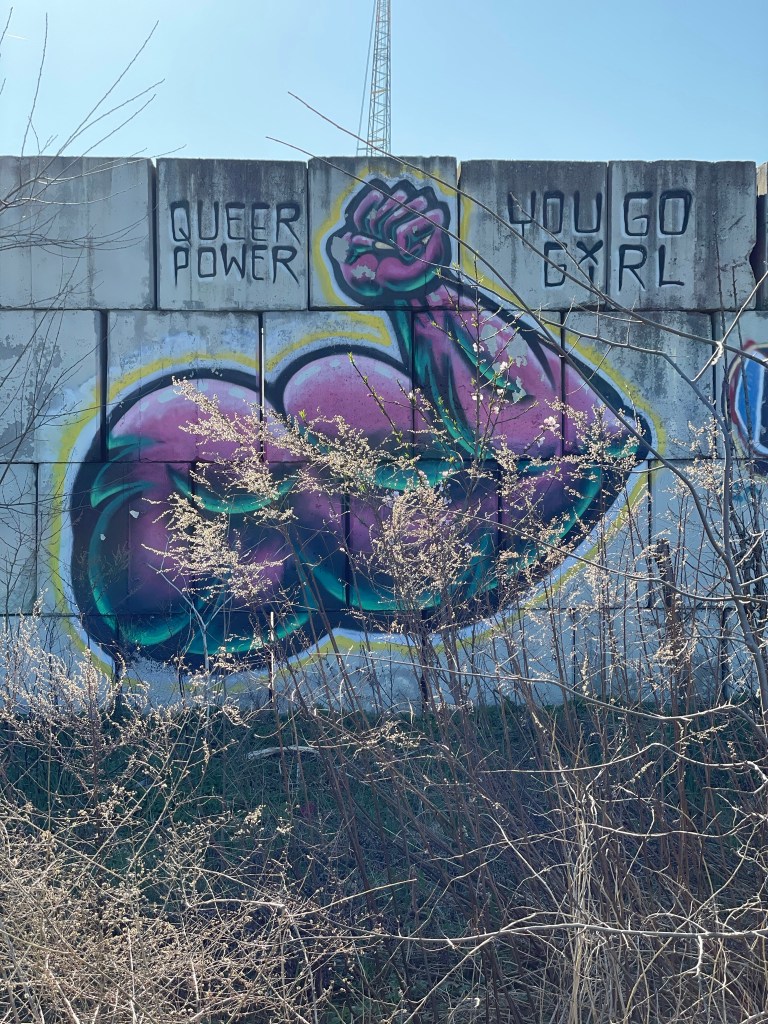
Two hours and over four hundred shots later, I’d had my creative fill. On my way out, I noticed a group of young men scouting the area, videographer equipment in tow. Pleasantly surprised, I waved from a distance. When they saw me, they stopped short, frozen. “Bright minds think alike,” I said with an ironic smile they couldn’t see through their wary, expressionless masks. Silence. Out of the corner of my eye I watched them stare after me, and then move on.
As I left the park, the main building of the Grain Terminal loomed over my shoulder, beckoning me to return. I agreed. With that feeling of unfinished business, I made a note to return one day.
In the time that passed, childhood, in the figurative sense, had given way to reality. The edict of the Millennial generation stated that beyond this point you either a) were who you were or b) you were dead, or c) needed to be, because by thirty you had to be something: rich, settled, married, successful in some way, or…
There was no, “or”.
I didn’t begin to shape my destiny with any great force until my late twenties, when the fading dissonance of college life/education – really a peer-reviewed refinement of skills I already possessed prior to going – lifted enough for me to realize that what I learned there wouldn’t be enough to make the life I wanted (re: NOT a creative life revolving around odd jobs which had nothing to do with my craft)
(You can be anything you want to be, though!)
At forty, it’s not so much my age that has changed me but my breadth of experiences informing me of what doesn’t work. Twenty years ago, the consideration of certain things – like a savings, or healthy sense of individualism and identity – didn’t make sense to prioritize until the passage of time crested like a wave over the current circumstance and made those things necessary. Risk as an older person really means that the Contra code for extra men was a fairytale older than the system it was birthed on. Like a key to a locked door you didn’t need to go through…until you did.
That’s why I ended up returning to the Grain Terminal. Because I had to.
Back on Bay Street, April 2023
The graffiti scrawled on the top story was a lighthouse beam in the storm (to come) directing me forward. That part hadn’t changed from my visit two years ago, but some things, in fact, had. The area (by extension) was a far cry from the semi-abandoned watershed it was two years ago, nearly to the day I was last there. Now it was looking like prime leisure space for patrons with disposable income.
History repeats. The patch of real estate that would be the Red Hook Houses began as a shanty town of some 400 homeless laborers and migrants. That’s where the four year-old NYCHA built it in 1939 (and then additional housing complexes, a West section, in 1955). The shores of Roode Hoek/Red Hook, renamed by the Dutch settlers who co-opted the land from the Lenape people in 1636 became a bustling, steadily-expanding shipping industry hub by the late 19th century. Thousands of pre-screened sailors and dock workers with their families found a home in those projects. Subliminally, these buildings are probably what most people think of when they think of Red Hook. It is the largest housing projects in this vast borough. In comparison to my very early childhood, I lived in the Edenwald Houses, the largest projects in the Bronx.
Across New York’s intermittent downturns, including the resounding echoes of the Great Depression which at that time had only just abated, progress also hurt this area. The Expressway (1946) and the Battery Tunnel (1950), the advancement of shipping technology that reduced labor demands (and then the mass exodus of white residents, which saw millions of dollars in revenue exit with them) set the stage to play out as it did across America at the expense of Black and brown citizens, the two main groups that replaced the Italian and Irish demographic in those apartments. By the mid-1970’s fiscal crisis and the ‘80s crack scourge, the community withered to an emaciated specter of its already-stunted potential, which then hung in a sort of suspended animation in contrast to the surrounding neighborhoods. Red Hook simply was not an urgent investment; no train lines or nearby supportive amenities, no cultural institutions. The area didn’t even have a bank until 1997.
Out of this long history the new soccer field, renovated Red Hook Play Center (now Sol Goldman Play Center) and all the restructuring to the green spaces around the grain terminal telegraphed an ironic – and familiar – death of progress. This blooming could have merely been a continuation of halted plans because of the pandemic…or the herald to something else. Contrasting my last visit to the empty streets, this early in the morning saw groups of young soccer teams already scrimmaging on the green. Faces incongruous to the general demographic walked about in pairs or with dogs, or jogged on the sidewalks like they had always been there.
I shook off the sense of foreboding and got my mind back on my purpose.
Construction was well underway throughout the park, which meant no stealthy entry points. Bulldozers and orange/white barricades were the scene, and the Columbia Street/Ikea-facing fence was replaced with a solid, green “Post No Bills” wall. My only entryway was through the park itself. I quickly hopped over the fence and into the ball field space, making my way along the white primer-painted walls formerly covered end to end with pro-queer, anti-corporate slogans. This wall, separating the grain terminal property from the park, was over ten feet tall. Using a nearby garbage can and an old spout jutting out of the wall as a foothold, I made my way over. The shipping containers stacked against the terminal side helped me get to the ground fairly easily.
I was officially in…and trespassing. Eyes peeled for every detail at once, I quickly made my way around the northeast end of the main building only to find its crumbling foundation bordered (partially submerged) by the waters of the canal. There was a possible way in from that end, but I was not prepared to swim to it There was no telling what pathogenic door prizes I’d win after a dip. Pass. I backtracked to the south end of the property and found any conventional methods for entering the terminal’s main building cut off by strategically-placed stones and welded metal grates on all the windows. From the visible graffiti within, I could see that many others had found a way in. Way before me. Disappointment bloomed in my chest like blood from a wound through a white shirt.
My late thirties had been a particularly difficult period of adversity. Inner monologues became more somber, mental ruts more pronounced, meaningful returns on efforts and compounded interest on past mistakes nudged me towards a darkness that solidified as time moved on. Life flows in rhythms of success, learning and failure – part of its ultimate cycle – but the past two years introduced me to a level of pain that I had never experienced before. How many more colossal failures (love, finances and career all at once – and the pandemic/quarantine was the knockout punch) could I bounce back from? I didn’t want to think about it. I did anyway.
None. I couldn’t take another hit of that magnitude again and survive. I knew that in my bones.
Death became real. Not as real as the heart attack my mother succumbed to the year before, or cancer, or some other withering illness that gave you time to ponder before the end. Death as an option, a viable option, at any time. Depression had taken root in my mind and crowded the space where strong will and confident direction used to be. Time had a long list of my troubles and the list of successes were much shorter.
I went farther down that rabbit hole, spinning a narrative that the Grain Terminal and I both represented – and failed – in the same ways. The structure was built as a double-down on another unsuccessful plan: the barge canal system, completed in 1918 was underscored by the grain terminal, constructed in less than a year in 1922 for the same purpose. It was a two-pronged vehicle of pointlessness. Before the doors opened for business the shipping industry had moved on to better options elsewhere. Ouch.
And the icing on the cake? Both the terminal and I were officially born in September, separated by 22 days across the scores of decades.
Two overachieving Virgos with little to show. Big ouch.
While it had very brief periods of successful utility after it was given over to the Port Authority of NY/NJ in 1946, it was shut down for good in 1965. Since then it’s been abandoned, half-considered.
While my imagination pummeled me. I reached the loading dock at the mouth of the Gowanus Canal where two ships were anchored. The Loujaine, a bulk carrier retired in ’85, was a permanent resident. I attempted to board her, but the entry gate to the deck was locked.
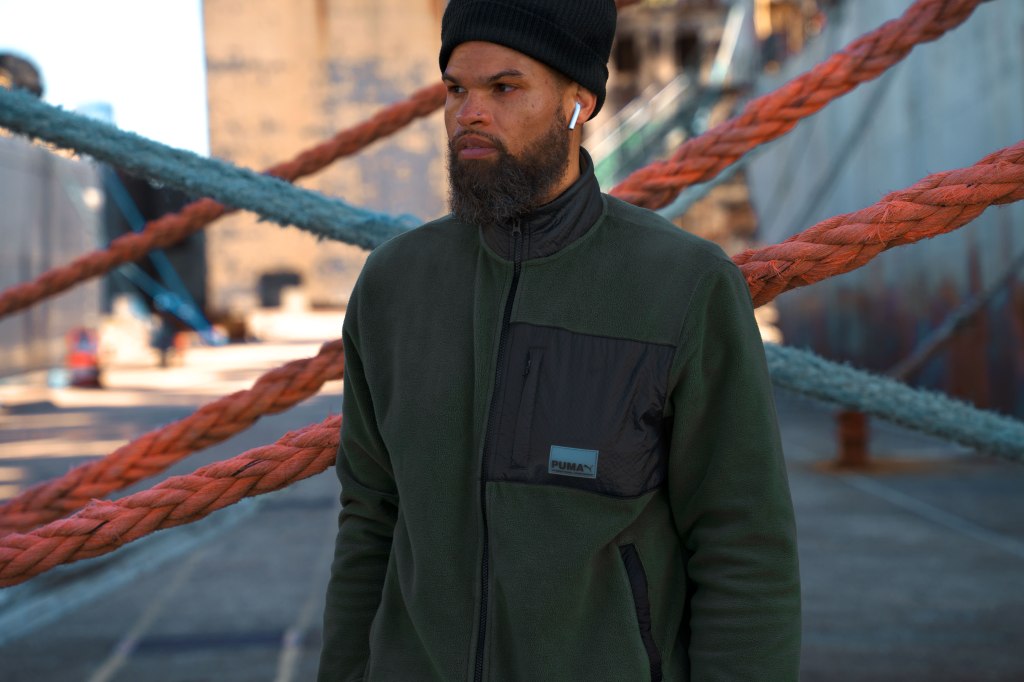
After a few self-portraits I backtracked to investigate the standalone buildings that seemed to have access, but all the staircases and landings were knocked away. The Transformer House was where I prevailed using muscle and creative hand/footholds to reach the upper floor. I found to my surprise graffiti reached even here. People thought it was worth it to scramble up here to make their mark on the world? Well, who was I to talk? I took more photos and self-portraits.


I ended up on the southeast side of the main building, a thin alleyway made by the outer edges of the building and the canal. Here, I saw a glimmer of hope. Someone had managed to peel the thin sheet metal covering off one window, but it was taller than my height. After some un-athletic attempts to reach it, that seemed the end to the excursion. As I made my way back to the shipping containers, ready to make my exit, something sparked within me…a kind of life, a kind of death. The slogans tugged at my conscience.
(You can be anything you want to be.)
(Don’t give up.)
An indescribable hunch compelled me back to the northeast end for a second look at the crumbling foundations. The waterline had receded, revealing stepping stone debris from the decaying foundation to an opening leading into the building.
And, even more interesting, there were pathways that other trespassers had left as a means to go inside – or straight up! Excited, I chose the more difficult of the two choices. The makeshift rope/metal/stick ladder placed there helped me reach the first story landing, another relative term; it was all held literally in thin air by the grace of the exposed steel rebars embedded in concrete that resembled hard-packed brown sugar. Undaunted, I continued up.
And up.
And up.
And up.
The higher I climbed the rusted staircase with missing steps and warped, unmoored banisters the more present I became to mortality.

The were easily a dozen ways (five of them where I was at that moment) a person could die here and never be found. Gazing down between the spaces of the rusted-away steps, the realization that I was easily the highest-situated living being (except for perhaps a seagull) for two miles in any direction put one perspective into my mind.
I did not want to die, after all.
But here I was, in a life-threatening situation, with no one here but me. No one to help.
I thought again of the Red Hook Houses community and the symbol it/they represented to America. Called “the worst place to live” in the 90’s, the “crime capital”; ignored, undercut and betrayed time and time again; in the days leading up to Hurricane Sandy, city officials opted out of preparations before the storm, anticipating a mild impact despite the neighborhood being a Zone 1 flood area. The subsequent deluge – more than five feet – deprived tenants of fresh water and power for months after. To this day, the state has yet to award the neighborhood with the full, promised funding. Then there was the lead contamination, constant power and heat outages, the socio-economic neglect over decades that went hand in hand with the ironically faithful reporting on the dysfunction – crime, delinquency, drug use/dealing – those elements engender, implicitly levying the blame on the residents’ frustration and not the decision makers. I thought of the areas being renovated for the short-term pleasure of others to visit, but the people who lived there were still marginalized.
No one was coming to save them, and out of this cycle the Red Hook Initiative came into being, a non-profit organization that focused on revitalization through the resource that ultimately determines a society’s future: the youth. Since RHI’s inception in 2002, they’ve invested in the Red Hook Houses residents, trained them during and after Sandy for future emergencies, facilitated a community garden which supplies local restaurants with produce, and even stewarded their telecommunications network via partnership with AmeriCorps. A mere 11% of their funding comes from the government.
Looking eight stories down with four more stories to go on that one-wrong-step-and-you’re-done staircase, nobody was coming to save me, either.
On the roof of the north facing tower I took in the expanse of Red Hook. I could hear the children on the soccer field; their voices carried, from thousands of yards away, shrieks of focus and competitiveness that clashed with the history of countless tags and graffiti markings all around me.
More doubt, more existential musings…
Who was I to explore, to be here? What was the point of all this? The question was the point. A new surge of energy, not altogether different from the kind which sustained me through all the ebbs and flows of my twenty-year speculative career in the arts, shot through me from head to toe. The question put more life in me. My camera at the ready, I photographed everything that spoke to me.
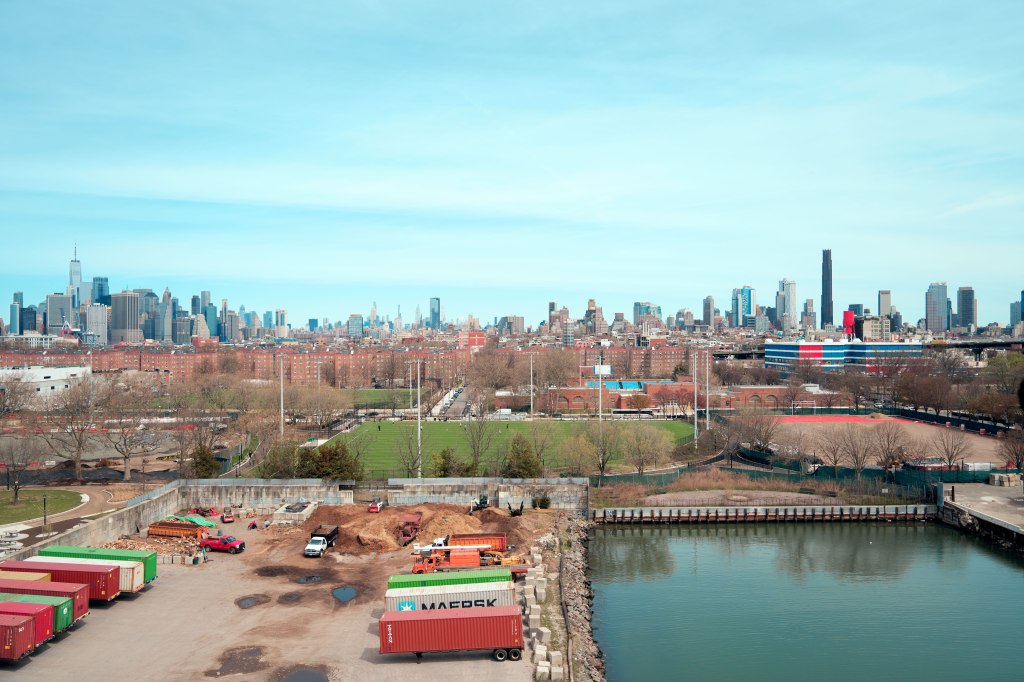
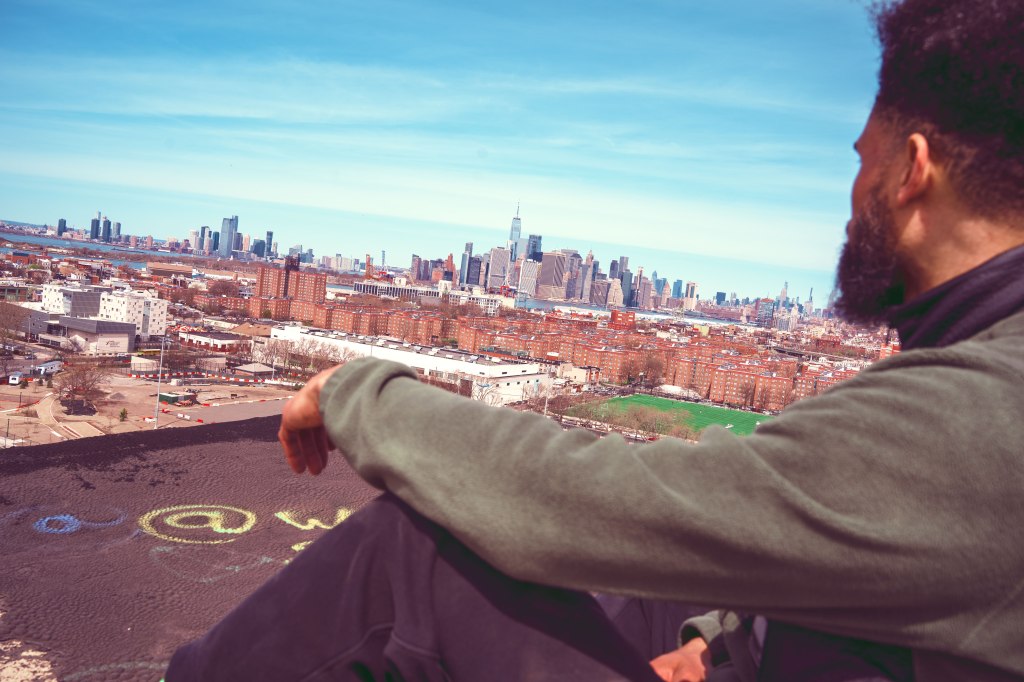
It would not be dramatic to say the Grain Terminal and I bonded in ways that only two Virgos can. I silently backtracked, climbed, hung, shimmied, crawled, goose-stepped and teetered my way through unsteady staircases, dark alcoves, rickety catwalks and demolished skylights. The terminal seemed to understand, because all of those structures held my weight. From the upper floors, I peered down the twelve-story length of a grain silo to the ground floor. Looking at the Loujaine from the top floor of the south building, I mused if she would be allowed to sail again.
I saved the ground floor for last and stood where the late David Bowie did when he shot his music video, “Valentine” in 2012; I meandered past the same places as the kids in Lorde’s “Team” video, shot in 2013.

The sight of two uniformed police officers approaching from the north end of the property underscored my overstayed welcome. Perhaps someone had seen me and reported it. I hadn’t exactly attempted to hide myself. Dodging through cargo containers and geese, who eyed me with a sort of fearless interest, I scrambled over the wall at the spot where I first entered. In my panic, my foot slipped on the garbage can, which sent me unceremoniously crashing on my ass. Thankfully unhurt, I jumped to my feet (I almost stopped to put the garbage can back in the exact place I took it from. Jeez) and darted to the fence I hopped over, mentally crossing my fingers for my luck to continue. Luck was on my side. I walked by the police car at the curb with nonchalant aplomb with nary a look back.
On the B61, dirty, laden with equipment and ignoring increasingly furtive stares from the shifting demographic of passengers as the bus traveled east, the energy of the adventure dissipated and I sank into the tiredness my body deferred. My mind – no surprise there – kept going, rationalizing the adventure, the grand scheme of all this. I didn’t come to know the technical term for what I’d done until a friend of mine, after recovering from the dismay and worry over my excursion, told me: Urbex (short for urban exploration). Others around the country, the world, were doing the same thing I had been apparently fetishizing for years. There were even photography contests that catered to this genre. Go figure. The experience had certainly quickened the blood, but it was far from the (stereo)typical attempt of an older person doing something typically young(er).
What should I be doing at my age? Sitting in an office, sedate and sedentary, shaking my fist at those “cooky” Gen Z kids? I think in lieu of entering abandoned property I could certainly do better than that. What would the child version of me say if we had an opportunity to meet now? Would I be a disappointment to him because I’m not a millionaire or a big star but a roadmap of mistakes, failures, and somehow still alive, scarred, still navigating?
As the water rinsed away the last of the day’s grime, dust and air of the uncharted, I reflected on the concept of success.
There is no finish line.
Success is the ability to indefinitely sustain one’s preferred level of quality. This requires action, and you can’t do that by sitting still. I don’t know if my much younger self would be proud of me, but I’m definitely proud of him for getting me where I am today.
The following morning I looked at the 256 images captured in that dangerous, historic, interesting, life-affirming place and had but one resounding thought:
When’s the next journey?
All photos credited to Lord Bison, 2023. For usage rights or full complement of all photos, contact author.
Sources: RHI website…….(Source 1)
Author’s Note: Just two weeks after this adventure, I learned the NYPD and the DEA/ATF conducted a joint raid on the Red Hook Houses to arrest five teenagers suspected of gang activity – in front of news cameras. The media spun it one way. Here’s an account from the people who actually live there. You decide which is true.

Thanks for reading! Tap here for more access to articles and essays.
 Dichotomie